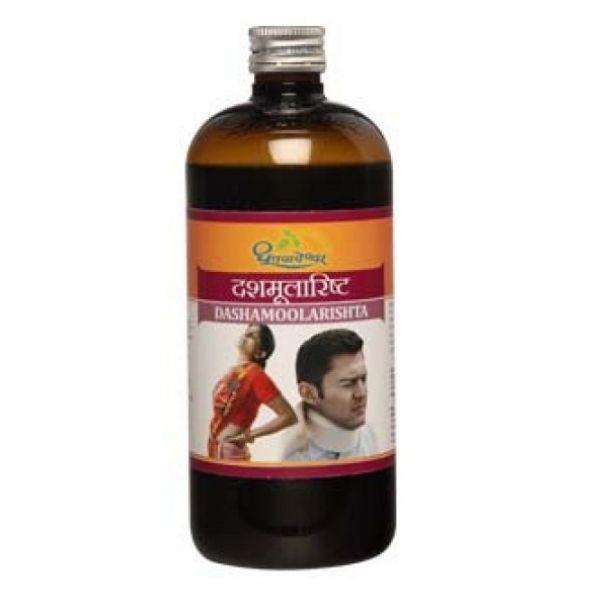
Dashmoolarishta
Dhootpapeshwar Ayurvedic Medicine - Dashmoolarishta
It is used in Dhatushaya, Kasa, Swasa, Arsa, Udararoga, Aruchi, Pandu, all type of vata disorders, Pradara, Kustha, Bhangdara, Mutrakricha, Amlapitta, Agnimandaya, Daurbalya, Kamla, Uterine disorders. It is mainly used in Vata-kaphaj diseases.
Dasha, which means ten, refers to the Ayurvedic tonic dashmularishta, which is made from the roots of ten distinct plants. The well-known Ayurvedic classic Sarngadhara Samhita states that Dashmularishta has the ability to rebuild tissues and revitalize the body in order to treat the body of an inflammatory disease. It is considered to be an excellent tonic for women going through the prenatal and perimenopausal phases.
Dashmoolarishta is a liquid Ayurvedic medication used to treat digestive issues, anemia, colds, coughs, and other ailments. 5% of the dasamoolarishtam's self-generated natural alcohol is present. The water and self-generated alcohol in the product serve as a vehicle for the body to absorb the active botanical ingredients that are soluble in both water and alcohol. Additionally known as Dasamularishtam.
Osteoarthritis, primarily affecting the hips and knees, is a common degenerative ailment of weight-bearing joints. The major cause of disability in the older population and a condition that affects a large portion of it is osteoarthritis. One of the greatest supplements to osteoarthritis treatment to lessen pain and inflammation brought on by joint inflammation is dashmularishta. Dashmularishta has been shown in animal experiments to dramatically reduce edoema and enhance the capacity for taking longer steps.
Arthritis pain can be adequately managed with dashmularishta. 4 One of the main components of Dashmularishta, Oroxylum indicum, is widely renowned for its ability to relieve pain. 3 Animal studies show that Dashmularishta in osteoarthritis can delay the start of pain-inducing stimuli, hence preventing the occurrence of pain. 2 Further research may reveal that humans can benefit from it as well.
This herbal concoction known as Dashmularishta in Ayurveda is useful for treating heart conditions. Blood clots can result in conditions including heart attacks and strokes. Dashmularishta is a great agent to avoid blood clots, heart attacks, and strokes since it can act against the clotting property of platelets. It may be combined with allopathic medications to treat heart conditions.
Dhootapapeshwar Dashmoolarishta Shloka
दशमूलानि कुर्वीत भागः पञ्चपनः पृथक् ॥ ८॥
पञ्चविंशत् पलं कुर्यात् चित्रकं पौष्करं तथा ।
कुर्यात् विंशत् पलं लोधं गुडूची तत्समा भवेत् ॥७९॥
पत्रः षोडशमिर्धात्री रविसङ्ख्यः दुरालभा ।
खदिरों बीजसारश्च पश्या चेति पृथक् पलैः ॥८०॥ ॥८५॥
अष्टभिर्गणितः कुष्ठं मञ्जिष्ठा देवदारु च ।
विज्ञ मधुकं भागी रूपित्थो अतः पुनर्नवा ॥ ८९ ॥
व्यं मांसी प्रियङ्गुश्च सारिवा कृष्णजीरकम् ।
त्रिवृता रेणुकं रास्ना पिप्पली क्रमुकः शठी ॥८२॥
हरिद्रा शतपुष्पा च पथकं नागकेशरम् ।
मुस्तं इन्द्रयवः शृगी जीवकर्षभको तथा ॥ ८३ ॥
मैदा चान्या महाभेदा काकोल्यो ऋद्धिवृद्धिके ।
कुर्यात् पृथक् दुद्विपत्रिकान् पचैदष्टगुणे जले ॥ ८४ ॥
चतुर्थाशं शृतं नीत्वा मृद्भाण्डे सन्निधापयेत् ।
चतुःषष्टिपत्रां द्राक्षां पचेन्नीरे चतुर्गुणे त्रिपादशेषं शीलं च पूर्वस्वाथे शृतं क्षिपेत् ।
दुवात्रिंशत् पनि सौद्रं दद्यात् गुडचतुःशतम् ॥८६॥
त्रिंशत्पलानि धातत्र्याः कको जलचन्दनम् ।
जातीफलं लव च त्वगेलापत्र केशरम् ॥ ८॥
पिप्पली चेति सञ्चूर्ण्य भागविपलिकः पृथक् ।
शाणमात्रां च कस्तूरी सर्वमेकत्र निक्षिपेत् ॥८॥
भूमौ निखातयेद् भाण्डं ततो जातरसं पिबेत् ।
कलकस्य फलं लित्वा रसं निर्मलतां नयेत् ॥८५॥
ग्रहणीमरुची श्वासं कासं गुल्म भगन्दरं ।
बालव्याधि क्षयं उदि पाण्डुरोगं च कामलाम् ॥१०॥
कुष्ठान्यशीसि मेहांश्च मन्दाग्निमुदराणि च ।
शर्करामश्मरी मूत्रकृच्छ्रं धातुक्षयं जयेत् ॥९९॥
कृशानां पुष्टिजननो बन्ध्यानां गर्भदः परः ।
अरिष्टो दशमूलाख्यस्तेजः शुक्रबलप्रदः ॥१२॥
शाङ्गधर संहिता मध्यम खण्ड १०/७८-१२
Dhootapapeshwar Dashmoolarishta Ingredients
In addition to water, honey, and jaggery, Dasamoolarishtam (Dashmoolarishta) has the following additional ingredients (gur).
Plumbago zeylanica Chitrak
Inula racemosa Pushkaramula
Symplocos racemosa Lodhra
Tinospora cordifolia Giloy/Guduchi
Emblica Officinalis Amla (Indian Gooseberry)
Fagonia cretica Dhamasa/Duralabha
Acacia catechu Khadira
Pterocarpus marsupium Vijayasar
Terminalia chebula Hareetki
Saussurea lappa Kuth/Kushta
Rubia cordifolia Manjishta
Cedrus deodara Deodar
Embelia ribes Vidanga (False Black Pepper)
Glycyrrhiza Glabra Mulethi (Yashtimadhu) – Licorice
Clerodendrum serratum Bharangi
Feronia limonia Kaith/katha/Kapitha
Terminalia bellirica Bhibitaki (behra)
Boerhavia diffusa Punarnava
Piper retrofractum Chavya
Nordostachys jatamansi – spikenard Jatamansi
Callicarpa macrophylla Priyangu
Hemidesmus indicus Sariva
Bunium persicum Kala jeera (black cumin)
Operculina turpethum Trivrit
Vitex negundo Nirgundi
Pluchea lanceolata Rasna
Piper longum Pippali (long pepper)
Areca catechu Puga (Betel nut)
Hedychium spicatum Shati
Curcuma longa Haldi (Turmeric)
Foeniculum vulgare Saunf (Fennel Seeds)
Prunus cerasoides Padmaka
Mesua ferrea Nagkesar
Cyperus rotundus Mustak (Nut grass)
Holarrhena antidysenterica Indrayava
Pistacia integerrima kakar singhi/ Karkatashringi
Pueraria tuberosa Jivaka
Microstylis wallichii Rishabhaka
Polygonatum cirrhifolium Meda
Asparagus racemosus Shatavari
Withania somnifera Ashwangandha
Dioscorea bulbifera Zimikand
Vitis Vinifera Draksha (Raisins)
Woodfordia fruticosa Dhataki
Piper cubeba Kabab-chini/Kankola (Cubeb pepper)
Coleus vettiveroides Jala
Santalum album Chandan
Myristica fragrans Jatiphala (nutmeg)
Syzygium aromaticum Laung (Clove)
Cinnamomum zeylanicum Dalchini (Cinnamon)
Elettaria cardamomum Ela (cardamom)
Cinnamomum tamala Tejpatta
Strychnos potatorum Nirmali/KatakaPhal
The first 54 medications must be washed, dried, and powdered. Then add them and soak them overnight in the specified amount of water. Place them on the stove and cut the amount in half. Now, clean and pulverize the formulation's kwatha herb. To obtain kwatha, add the specified amount of water, let it sit overnight, then boil the liquid, reduce it to 14, and filter.
Gather the kwatha in one place and whisk it until it is thoroughly combined. Until it is entirely dissolved, add the remaining component to the formulation after grinding the Prakshepa dravyas into a fine powder. Add dhataki, madhu, and prakshepa dravyas to the filtered product after transferring it to a clean container. Seal the container, leave it alone to ferment, and check on it every few hours until it is completely fermented.
Dhootapapeshwar Dashmoolarishta Benefits
An ayurvedic tonic with a wide range of medicinal advantages is dashmularishta. The properties are listed below, of them.
Analgesic
Anti-inflammatory
Anthelminthic
Anti-inflammatory (acts against worm infections)
anti-bronchitis (acts against bronchitis)
Anti-vitiligo or anti-leucoderma (to manage the loss of skin color)
Against anorexia (manages eating disorders)
anti-diarrheal
anti-otorrhagic
anti-dysentery (ear infections)
Low blood sugar
liver-protective
antifungal
antimicrobial
antioxidant
Protects the kidneys from pollutants.
Immunomodulatory activity enhances immunity.
The anti-hyperlipidemic property lowers the levels of bad cholesterol, total cholesterol, and triglycerides (Low-Density Lipoprotein – LDL).
Additionally, it raises healthy cholesterol (High-Density Lipoprotein – HDL).
Reduces acid production in the stomach and protects against gastric ulcers.
Dhootapapeshwar Dashmoolarishta Dosage
Immediately following a meal, take 20 ml (or 4 tsp) of u dasamoolarishtam with an equal amount of water. The daily maximum dose is 60 ml.
The usage of Dashmoolarishta has no set time limit. Its minimum suggested course of treatment typically lasts between three and six months. When used under the guidance of an ayurvedic doctor, it is also safe to utilize for a longer period of time.
Dhootapapeshwar Dashmoolarishta Reference
Sharangdhara Samhita Madhyama Khanda 10/78-92.
Disclaimer
While we strive to provide complete, accurate, and expert-reviewed content on our 'Platform', we make no warranties or representations and disclaim all responsibility and liability for the completeness, accuracy, or reliability of the aforementioned content. The content on our platform is for informative purposes only, and may not cover all clinical/non-clinical aspects. Reliance on any information and subsequent action or inaction is solely at the user's risk, and we do not assume any responsibility for the same. The content on the Platform should not be considered or used as a substitute for professional and qualified medical advice. Please consult your doctor for any query pertaining to medicines, tests and/or diseases, as we support, and do not replace the doctor-patient relationship.