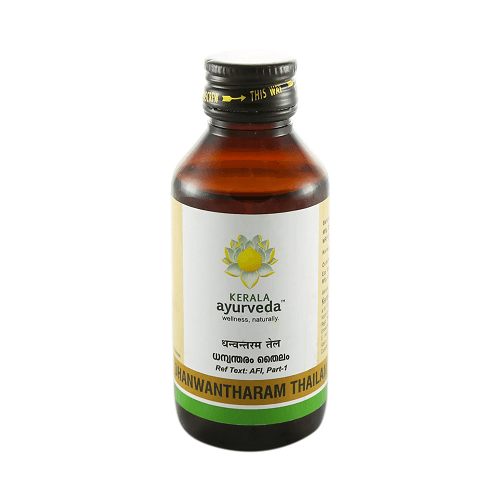
Dhanwantharam Thailam
Kerala Ayurveda Dhanwantharam Thailam
Kerala Ayurveda Dhanwantharam Thailam: It is used to treat ailments caused by the Vata dosha, including rheumatoid and osteoarthritis, spondylosis, headaches, and neuromuscular disorders.
An ayurvedic oral medication called Kerela ayurveda Dhanwantharam Thailam is effective in treating neurological and rheumatic diseases like paralysis and arthritis. Women receive it for prenatal and postnatal treatment as well. It possesses analgesic and anti-inflammatory qualities. This dhanwantaram tailam, is an oil prepared from a variety of substances, including Bala (also known as country mallow or Sida cordifolia), ksheera (cow's milk), and taila (sesame oil).
It is used to treat ailments caused by the Vata dosha, including rheumatoid and osteoarthritis, spondylosis, headaches, and neuromuscular disorders. It is used to treat neurological diseases such as neuritis, neuralgia, paralysis, facial palsy, and others. It is also used to treat rheumatoid arthritis, osteoarthritis, neck discomfort, and back pain caused by spondylosis.
Here is how the oil can be used in different ways -
It's applied in massage.
It is utilized in Ayurvedic treatments like basti and Dhara, among others.
For oral administration, Dhanwantharam, an oil that has been refined 101 times, is used. 5–20 drops orally, once or twice day, before meals, in warm water or warm milk, according to the Ayurvedic doctor's instructions.
Babies can also be massaged with it.
To treat urinary disorders, bloating, and fever, internal usage is indicated.
After birth, this oil is used to massage women to increase their bodily strength
It is commonly known that dhanwantharam oil improves general health. Even pregnant women and new mothers are advised to follow this recipe. The formula is supposed to help with anxiety reduction and muscle relaxation.
Diet and Behavior for Dhanwantharam Thailam are Recommended
We can include fatty fish, garlic, ginger, walnuts, and grapes in our daily diet plan.
Avoid heavy lifting, protracted sitting, and unpleasant sleeping positions.
Kerala Ayurveda Dhanwantharam Thailam Shloka
(धान्वन्तरं तलम्)
बलामूलकषायस्य भागाः षट् पयसस्तथा ।
यवकोलकुलत्थानां दशमूलस्य चैकतः ॥
निष्क्वाथभागो भागश्च तैलस्य च चतुर्दश द्विमेदादारु मञ्जिष्ठाकाकोलीद्वयचन्दनैः ॥
सारिवाकुष्ठतगरजीवकर्षभसैन्धवैः ।
कालानुसारीशैलेय वचाऽगुरू पुनर्नवैः ॥
अश्वगन्धावरीक्षीरशुक्लायष्टीवरारसैः ।
शताह्वाशूर्पपर्णेला त्वक्पत्रैः श्लक्ष्णकल्कितैः ॥
पक्वं मृद्वग्निना तैलं सर्ववातविकारजित् ।
सूतिकाबालमर्मास्थिक्षतक्षीणेषु पूजितम् ॥
ज्वरगुल्मग्रहोन्माद मूत्राघातान्त्रवृद्धिजित् ।
धन्वन्तरेरभिमतं योनिरोगक्षयापहम् ॥
सहसंयोग तैल योग प्रकरण
Kerala Ayurveda Dhanwantharam Thailam Ingredients
Tailam ingredients
Bala moola - Sida cordifolia
Water for decoction
Paya - Cow milk
Yava - Barley - Hordeum vulgare
Kola - Zyziphus jujuba
Kulattha Dolichos biflorus
Dashamoola - group of ten roots
Bilva - Aegle marmelos
Agnimantha - Premna mucronata
Shyonaka - Oroxylum indicum
Patala - Stereospermum suaveolens
Gambhari - Gmelina arborea
Brihati - Solanum indicum
Kantakari - Solanum xanthocarpum
Gokshura - Tribulus terrestris
Shalaparni - Desmodium gangeticum
Prishnaparni - Uraria picta
Taila - Oil of Sesamum Indicum
Meda - Polygonatum cirrhifolium
Mahameda - Polygonatum verticillatum
Daru - Cedrus deodara
Manjishta - Rubia cordifolia
Kakoli - Fritillaria roylei
Ksheera kakoli - Lilium polyphyllum
Chandana - Pterocarpus santalinus
Sariva - Hemidesmus indicus
Kushta - Saussurea lappa
Tagara - Valeriana wallichi
Jeevaka - Malaxis acuminata
Rishabhaka - Manilkara hexandra
Saindhava Lavana
Kalanusari - Valeriana wallichi
Shaileya - Convolvulus pluricaulis
Vacha - Acorus calamus
Agar - Aquilaria agallocha
Punarnava - Boerhaavia diffusa
Ashwagandha - Withania somnifera
Shatavari - Asparagus racemosus
Ksheerashukla - Ipomoea mauritiana
Yashti Glycyrrhiza glabra
Haritaki - Terminalia chebula
Vibhitaki - Terminalia bellirica
Amla - Emblica officinalis
Shatahva Anethum sowa
Mashaparni - Teramnus labialis
Mudgaparni - Phaseolus trilobus
Ela - Cardamom - Elettaria cardamomum
Twak - Cinnamon - Cinnamomum camphora
Patra - Cinnamomum tamala
Method of Preparation
To make Bala decoction, coarse Bala powder is boiled with a certain amount of water until it is reduced to one-eighth part, then it is filtered. Separate preparations are made for the Yava to Prishnaparni decoction. A sufficient amount of water is combined with ingredients from Meda to Patra to create a homogeneous paste.
Murchita sesame oil is heated by stirring continuously while adding milk, paste, and decoction. When froth appears over the oil and there is no moisture present, the heating is stopped. The oil is placed on fire and tested for the lack of a crackling sound to confirm the absence of moisture. It is filtered, chilled, and kept in a container with a tight seal.
When created using the Avartana method, this taila is known as Dhanvantara Taila Avartana, in which the procedure of creating the oil is repeated 101 times.
Sida Cordifolia, or Balamoola
Due to its benefits as a potent analgesic, diuretic, antipyretic, antiviral, antioxidant, anti-rheumatic, immune-enhancer, hypoglycemic, and hepatoprotective plant, it is utilized in Ayurvedic medicine.
It is very helpful in the Ayurvedic remedies for neurodegenerative and neuromuscular diseases.
Vata Dosha-related issues are treated with Bala.
Barley, yava, and hordeum vulgare
It is employed as a fat scraper in conventional medicine to treat obesity.
It is utilized in traditional medicine across the globe to hydrate patients.
It has antipyretic and diuretic properties naturally.
It strengthens the Vata Dosha and reduces Kapha and Pitta vitiation's signs and symptoms.
Zyziphus Jujuba - Kola
This is the Chinese apple or Indian jujube.
It has a lot of vitamin C.
In Ayurvedic medicine, it is employed.
Kerala Ayurveda Dhanwantharam Thailam Benefits
One of the pain-relieving oils is Dhanwantharam Thailam, which is effective in treating neuromuscular problems and rheumatic diseases. Additionally, it functions as an analgesic and aids in reducing pain and inflammation in joints, bones, tendons, and cartilage. One of the greatest massage oils manufactured with natural ingredients is this one. The oil is beneficial for stiff shoulders and inflamed muscles, as well as for muscle tension and joint pain.
Another natural nerve tonic that is considered to be beneficial for preserving the nervous system and all of its functions is Dhanwantharam Thailam Ayurvedic massage oil. It is considered to be good for the neurological and musculoskeletal systems and calms aggressive Vata. This Ayurvedic body massage oil is intended to treat spondylosis-related back pain, neck pain, osteoarthritis, and rheumatoid arthritis.
Kerala Ayurveda Dhanwantharam Thailam Dosage
Oral administration of 5 to 20 drops twice daily with warm water or warm milk before meals.
Used as needed for massage.
Kerala Ayurveda Dhanwantharam Thailam Shelf Life
3 years.
Kerala Ayurveda Dhanwantharam Thailam Reference
Sahasrayoga Tailayoga Prakarana 1, Astana Hridayam.
Disclaimer
While we strive to provide complete, accurate, and expert-reviewed content on our 'Platform', we make no warranties or representations and disclaim all responsibility and liability for the completeness, accuracy, or reliability of the aforementioned content. The content on our platform is for informative purposes only, and may not cover all clinical/non-clinical aspects. Reliance on any information and subsequent action or inaction is solely at the user's risk, and we do not assume any responsibility for the same. The content on the Platform should not be considered or used as a substitute for professional and qualified medical advice. Please consult your doctor for any query pertaining to medicines, tests and/or diseases, as we support, and do not replace the doctor-patient relationship.