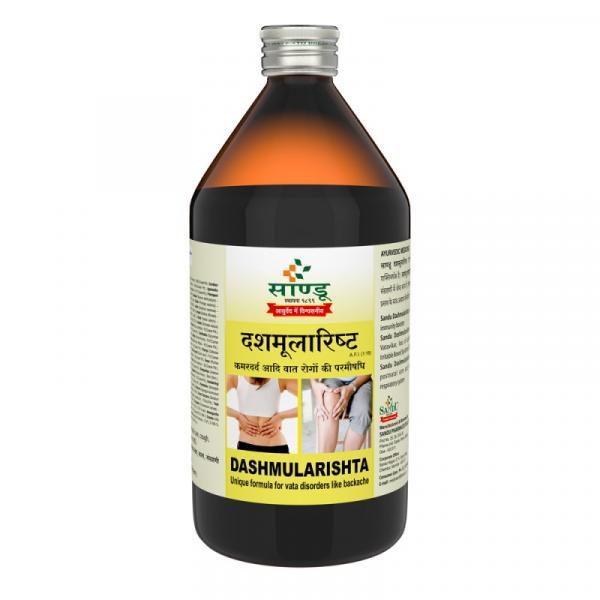
Dashmularishta
Sandu Dashmularishta Buy 200ml Online
Sandu Dashmularishta: It boosts vigour and lessens lassitude. It also helps women maintain their best health and is particularly helpful for female problems. It boosts vigour and lessens lassitude.
The traditional formulation of mixing 10 (das) beneficial roots forms the basis of dashmoolarishta (mool). It helps women, in particular, increase their strength and energy. Sandu Dashmoolarista treats disorders like fever, cough, postpartum weakness, infectious diseases of the kidney, bladder, and uterus, as well as digestive issues like diarrhea, irritable bowel syndrome (IBS), and appetite loss.
This traditional Ayurvedic mixture is also useful for treating arthritis-related pain and muscle and bone stiffness. This Ayurvedic liquid medicine sandu Dasamoolarishtam, also spelled Dashmularishta or Dashmoolarishta, is used as a painkiller and health tonic. Because it is made by fermenting herbs, it includes 3 to 7% self-generating alcohol.
It boosts vigour and lessens lassitude. It also helps women maintain their best health and is particularly helpful for female problems. It is frequently used in women to prevent postpartum issues such as uterine, bladder, and kidney infections, backaches, exhaustion, perineal pain, excess discharge, postpartum depression, a slow uterus, swollen breasts, etc.
Additionally, it strengthens ligaments, bones, and muscles while enhancing immunity. This causes it to become well-known among Indian women and a typical treatment for postpartum issues. In all of the aforementioned ailments, Sandu dasamoolarishtam (Dashmoolarishta) is useful.
Ayurveda claims that it strengthens the body and calms the Vata. Additionally, it cleanses and detoxifies the uterus. As a result, it is typically used right away following delivery. We will now talk about some significant medical applications and advantages of Sandu dasamoolarishtam.
Dasamoolarishtam does not effectively treat IBS, but it does increase appetite, lessen bloating, and provide body vigour. IBS sufferers frequently feel weak. Dashmularishta is more beneficial in this situation. Men who have put in their seminal fluid may benefit from the Dasamoolarishtam.
Sandu Dashmularishta Shloka
दशमूलानि कुर्वीत भागः पञ्चपनः पृथक् ॥ ८॥
पञ्चविंशत् पलं कुर्यात् चित्रकं पौष्करं तथा ।
कुर्यात् विंशत् पलं लोधं गुडूची तत्समा भवेत् ॥७९॥
पत्रः षोडशमिर्धात्री रविसङ्ख्यः दुरालभा ।
खदिरों बीजसारश्च पश्या चेति पृथक् पलैः ॥८०॥ ॥८५॥
अष्टभिर्गणितः कुष्ठं मञ्जिष्ठा देवदारु च ।
विज्ञ मधुकं भागी रूपित्थो अतः पुनर्नवा ॥ ८९ ॥
व्यं मांसी प्रियङ्गुश्च सारिवा कृष्णजीरकम् ।
त्रिवृता रेणुकं रास्ना पिप्पली क्रमुकः शठी ॥८२॥
हरिद्रा शतपुष्पा च पथकं नागकेशरम् ।
मुस्तं इन्द्रयवः शृगी जीवकर्षभको तथा ॥ ८३ ॥
मैदा चान्या महाभेदा काकोल्यो ऋद्धिवृद्धिके ।
कुर्यात् पृथक् दुद्विपत्रिकान् पचैदष्टगुणे जले ॥ ८४ ॥
चतुर्थाशं शृतं नीत्वा मृद्भाण्डे सन्निधापयेत् ।
चतुःषष्टिपत्रां द्राक्षां पचेन्नीरे चतुर्गुणे त्रिपादशेषं शीलं च पूर्वस्वाथे शृतं क्षिपेत् ।
दुवात्रिंशत् पनि सौद्रं दद्यात् गुडचतुःशतम् ॥८६॥
त्रिंशत्पलानि धातत्र्याः कको जलचन्दनम् ।
जातीफलं लव च त्वगेलापत्र केशरम् ॥ ८॥
पिप्पली चेति सञ्चूर्ण्य भागविपलिकः पृथक् ।
शाणमात्रां च कस्तूरी सर्वमेकत्र निक्षिपेत् ॥८॥
भूमौ निखातयेद् भाण्डं ततो जातरसं पिबेत् ।
कलकस्य फलं लित्वा रसं निर्मलतां नयेत् ॥८५॥
ग्रहणीमरुची श्वासं कासं गुल्म भगन्दरं ।
बालव्याधि क्षयं उदि पाण्डुरोगं च कामलाम् ॥१०॥
कुष्ठान्यशीसि मेहांश्च मन्दाग्निमुदराणि च ।
शर्करामश्मरी मूत्रकृच्छ्रं धातुक्षयं जयेत् ॥९९॥
कृशानां पुष्टिजननो बन्ध्यानां गर्भदः परः ।
अरिष्टो दशमूलाख्यस्तेजः शुक्रबलप्रदः ॥१२॥
शाङ्गधर संहिता मध्यम खण्ड १०/७८-१२
Sandu Dashmularishta Ingredients
In addition to water, honey, and jaggery, Sandu Dasamoolarishtam (Dashmoolarishta) has the following additional ingredients (gur).
Plumbago zeylanica Chitrak
Inula racemosa Pushkaramula
Symplocos racemosa Lodhra
Tinospora cordifolia Giloy/Guduchi
Emblica Officinalis Amla (Indian Gooseberry)
Fagonia cretica Dhamasa/Duralabha
Acacia catechu Khadira
Pterocarpus marsupium Vijayasar
Terminalia chebula Hareetki
Saussurea lappa Kuth/Kushta
Rubia cordifolia Manjishta
Cedrus deodara Deodar
Embelia ribes Vidanga (False Black Pepper)
Glycyrrhiza Glabra Mulethi (Yashtimadhu) – Licorice
Clerodendrum serratum Bharangi
Feronia limonia Kaith/katha/Kapitha
Terminalia bellirica Bhibitaki (behra)
Boerhavia diffusa Punarnava
Piper retrofractum Chavya
Nordostachys jatamansi – spikenard Jatamansi
Callicarpa macrophylla Priyangu
Hemidesmus indicus Sariva
Bunium persicum Kala jeera (black cumin)
Operculina turpethum Trivrit
Vitex negundo Nirgundi
Pluchea lanceolata Rasna
Piper longum Pippali (long pepper)
Areca catechu Puga (Betel nut)
Hedychium spicatum Shati
Curcuma longa Haldi (Turmeric)
Foeniculum vulgare Saunf (Fennel Seeds)
Prunus cerasoides Padmaka
Mesua ferrea Nagkesar
Cyperus rotundus Mustak (Nut grass)
Holarrhena antidysenterica Indrayava
Pistacia integerrima kakar singhi/ Karkatashringi
Pueraria tuberosa Jivaka
Microstylis wallichii Rishabhaka
Polygonatum cirrhifolium Meda
Asparagus racemosus Shatavari
Withania somnifera Ashwangandha
Dioscorea bulbifera Zimikand
Vitis Vinifera Draksha (Raisins)
Woodfordia fruticosa Dhataki
Piper cubeba Kabab-chini/Kankola (Cubeb pepper)
Coleus vettiveroides Jala
Santalum album Chandan
Myristica fragrans Jatiphala (nutmeg)
Syzygium aromaticum Laung (Clove)
Cinnamomum zeylanicum Dalchini (Cinnamon)
Elettaria cardamomum Ela (cardamom)
Cinnamomum tamala Tejpatta
Strychnos potatorum Nirmali/KatakaPhal
The first 54 medications must be washed, dried, and powdered. Then add them and soak them overnight in the specified amount of water. Place them on the stove and cut the amount in half. Now, clean and pulverize the formulation's kwatha herb. To obtain kwatha, add the specified amount of water, let it sit overnight, then boil the liquid, reduce it to 14, and filter.
Gather the kwatha in one place and whisk it until it is thoroughly combined. Until it is entirely dissolved, add the remaining component to the formulation after grinding the Prakshepa dravyas into a fine powder. Add dhataki, madhu, and prakshepa dravyas to the filtered product after transferring it to a clean container. Seal the container, leave it alone to ferment, and check on it every few hours until it is completely fermented.
Sandu Dashmularishta Benefits
The healing benefits of Dasamoolarishtam (Dashmoolarishta) are as follows
Anti-inflammatory
muscle-relaxing drug
Anti-arthritic
gentle natural Analgesic
Digestive Stimulant
Antioxidant
Antibacterial\sAdaptogenic)
Haematinic (increases hemoglobin levels)
moderate anthelmintic (due to vidanga)
Therapeutic Indications for Antidepressants that Reduce Stress
Carminative
The following medical disorders can benefit from Dasamoolarishtam (Dashmularishta).
Dysmenorrhea (menstrual cramps) (menstrual cramps)
Multiple miscarriages
inflamed vulvar tissue
Backache
postpartum depression (baby blues)
perinatal weakness
the following pregnancy, anemia
pus in seminal fluid is the cause of male infertility.
cough (Vataj Kash)
reduced appetite
Indigestion
Gas
Rarely used is irritable bowel syndrome (IBS).
Jaundice\sPiles.
Sandu Dashmularishta Dosage
Immediately following a meal, take 20 ml (or 4 tsp) of sandu dasamoolarishtam with an equal amount of water. The daily maximum dose is 60 ml.
The usage of Dashmoolarishta has no set time limit. Its minimum suggested course of treatment typically lasts between three and six months. When used under the guidance of an ayurvedic doctor, it is also safe to utilize for a longer period of time.
Sandu Dashmularishta Shelf Life
All varieties of Arishta and Asava, especially Dashmularishta, are said to taste finest when they are old and have beyond their expiration date, according to ancient literature. Today, many Arishta and Asava formulations contain an expiration date that might range from 5 to 10 years.
Sandu Dashmularishta Reference
Sharangdhara Samhita Madhyama Khanda 10/78-92, Bhaishajyaratnavali.
Disclaimer
While we strive to provide complete, accurate, and expert-reviewed content on our 'Platform', we make no warranties or representations and disclaim all responsibility and liability for the completeness, accuracy, or reliability of the aforementioned content. The content on our platform is for informative purposes only, and may not cover all clinical/non-clinical aspects. Reliance on any information and subsequent action or inaction is solely at the user's risk, and we do not assume any responsibility for the same. The content on the Platform should not be considered or used as a substitute for professional and qualified medical advice. Please consult your doctor for any query pertaining to medicines, tests and/or diseases, as we support, and do not replace the doctor-patient relationship.